What is MF membrane (microfiltration membrane)? Differentiation from UF membrane and sand filtration [Basic Knowledge]
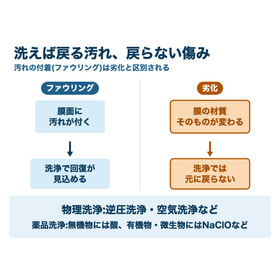
MF membranes that separate turbidity and bacteria through membrane pores. This will explain how to differentiate their use from sand filtration and UF membranes, along with the concepts of membrane differential pressure and cleaning observed during operation.
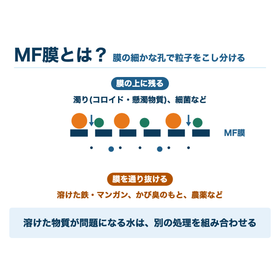
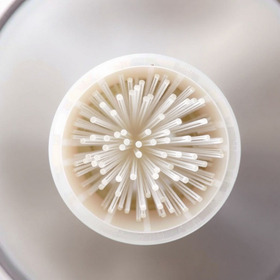
MF membrane (microfiltration membrane) is a membrane with fine pores that separates particles in water. According to the design guidelines for water supply facilities, it is categorized as a membrane that removes colloids, suspended substances, bacteria, and other sources of turbidity. Membranes with relatively large pores, around 2μm, are also used for the purpose of removing Cryptosporidium. ■ How is it different from sand filtration? In rapid filtration, coagulants are used to aggregate turbidity into flocs, which are then settled and filtered through a layer of sand. In contrast, MF membranes separate particles directly through the membrane itself. Therefore, coagulants are either unnecessary or only required in small amounts. The ease of automation and the smaller installation area are also reasons why membranes are chosen. There are different shapes of membranes, including hollow fiber type, which bundles thin tubes, and flat sheet type, which arranges flat membranes. ■ Dissolved substances pass through The primary function of MF membranes is to remove substances that are not dissolved in water. Dissolved iron, manganese, substances that cause musty odors, and pesticides can pass through the membrane. For water where these substances are problematic, additional treatments are combined before and after. In other words, the less dissolved substances present in the water, the more effectively the advantages of membrane filtration can be utilized. Please feel free to consult with us.
- Company:トリイ
- Price:Other